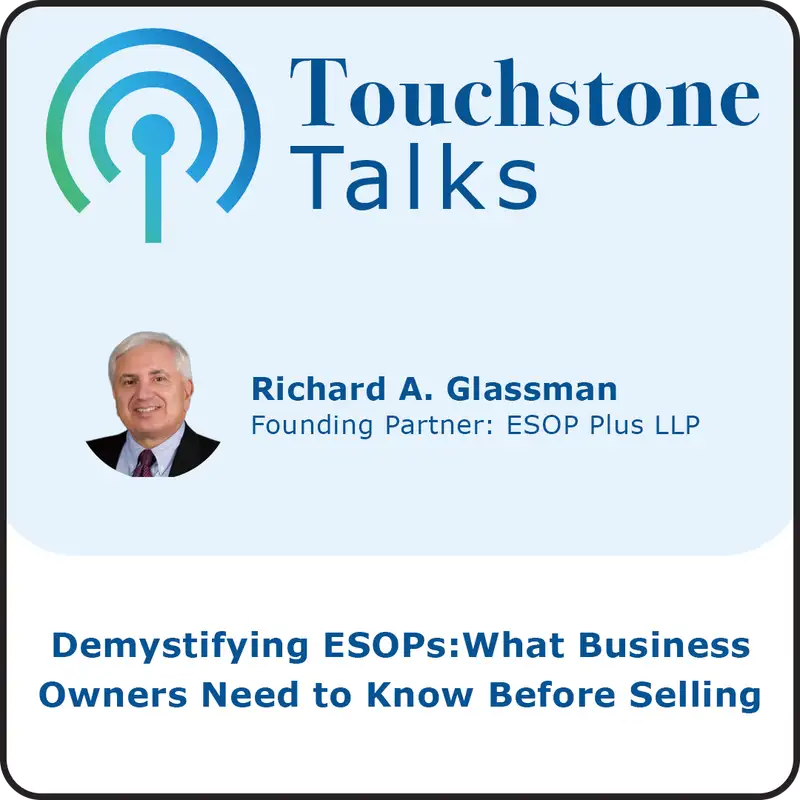
Touchstone Talks: Ep. 12 - Demystifying ESOPs: What Business Owners Need to Know Before Selling
One of my pet sayings
is that esops are the best kept secret
in the tax code.
I hope someday I can't say that.
In other words, I hope someday they're
more well known and well appreciated.
But that's where we are today. Great.
Well, thank you for that.
So Rick is joining us from Aesop.
Plus he's here to help us
kind of demystify esops
what they are, what you may have heard,
why it is or isn't true.
Thank you for joining Touchstone Talks
today.
It's my pleasure to be here.
Great. So
pretend I know nothing about Esops.
Give me, like, the the elevator pitch.
I was going to use those same words
myself.
Little quick elevator pitch.
I think it's worth going back.
Unfortunately, because it is a long time
ago, and I'm still talking
that they're not as well known as as maybe
they should be, at least in my opinion.
But let's go back to the 1960s
and early 1970s.
The general thoughts back then,
and you might agree with me
that those some of these,
those same thoughts are still evident
today,
was that the average American worker
did not put away enough money
for retirement.
That might still be true that that that's
they were saying that, believe it or not,
more than 50 years ago, maybe still true
today, I would say like they,
in addition, wealth concentration
is that the ownership level
of the business, not at the worker level,
no matter how much you make per hour,
believe it or not, they were talking about
wealth, concentration,
the concentration of money in this country
at the ownership level,
not at the worker level.
And they came up with this concept at use.
A gentleman named Louis
Kelso came up with the concept of
sharing the wealth of the business
through a retirement plan
for the employees
so that it is a retirement plan,
not a short term bonus plan,
but through a retirement plan.
If we could share the wealth
of the business with the employees,
we'd be sharing wealth,
taking away from concentration,
adding to retirement savings
and hopefully creating maybe even
a better company and a better economy.
And believe it or not,
they were saying that over 50 years ago.
You might say we still have some of
those problems here in our economy today.
So when Washington,
wants us to do something,
when our legislature,
legislature, legislators in Washington
want us to,
move in a direction one to when
sent us to do something, what do they do?
What is their main tool?
I don't care whether it's charitable
contributions, investing in your business,
buying a house.
The main
tool our legislature in Washington
has is tax benefits tax credits.
So when Orissa was adopted
1974, we're talking 51 years ago
now in in Orissa,
they actually incent inserted
tax benefits relating to a retirement plan
focused on the value of the business.
And that's really what an Esop is.
So for over 50 years,
Congress has been saying
and many people, believe it's
appropriate, maybe just not enough yet
that the best way to share the wealth
or a good way
to share the wealth, a good alternative
for selling your business
and getting a fair price
and giving tax benefits
would be to sell your business,
a privately held business, to when Esop
to a benefit plan, a retirement plan
for the benefit of all of the employees.
And that's really what it Esop is
at the beginning of the Esop transaction.
It's a liquidity event.
It's a sale of the business,
a sale of some or all of the equity
in the business,
just like any business owner might wish.
He or she may come a time in their career,
come a time
in the evolution of the business
where it's time for them to get liquidity
for,
for the
ownership in their, in their business.
And I think we all know
and I didn't create the,
the saying the silver tsunami
we are living through the silver tsunami,
the baby boomer generation with hair
the color of mine, who owned businesses,
who were looking to get liquidity,
whether they're ready to exit or not,
but they're looking to get liquidity.
So at the beginning of the day,
the Esop transaction
is that liquidity event
for the owner of the business.
At the end of the transaction,
you've created a retirement program
for your employees
based upon the value of the business,
based upon the value of the stock,
the equity of the company.
These people work for,
the employees work for.
And if you're willing to do that,
and it's not right,
I'll be the first one to say
it's not right in every situation.
But I do believe every time,
and I mean this very seriously
every time a liquidity event
is being considered, the Esop alternative.
And notice
I said it's just one of the alternatives.
But I say the Esop alternative
should be considered.
And to incent
business owners to think about the Esop
alternative,
to incent companies to take on the cost
of putting in now
a new retirement plan for their employees,
maybe in addition to A41K plan,
that they may already have
to incent the company
to incent the business owner.
Wonderful.
Tax benefits have been, provided
there are potential tax benefits
for the seller.
They're potential tax benefits
for the company.
And like I said before, there
there is a movement for employee ownership
that's started 51 years ago.
As we get into our discussion,
I think I can share with you
some thoughts
on, on the speed, on the acceleration
that we're seeing finally today
in employee ownership.
So hopefully that gives you a little bit
of a teaser on what an Esop is.
And and truthfully why we have them.
Well, let me do let me do a quick recap
to make sure I understand.
So if I'm an owner and I'm sitting here
and I'm listening,
this is an opportunity for me to consider
a different way to exit my business,
where I can essentially sell it
to a an employee owned program.
Yes. You're selling it actually
to a benefit plan trust
to a retirement plan
trust for the benefit of your employees.
So but I still get to take my money
out of the company.
Right.
That's the liquidity event part, right?
You are selling your shares.
I think we all know
there are different ways
for owners of businesses
to get liquidity for their shares.
Certainly private equity
is one of the big alternatives today.
You know, you open up the newspaper
and certainly the business section
of the newspaper, and there's probably
a story about private equity.
A competitor might want to buy
your business.
An investor may want to buy your business,
their dividend recap recapitalization.
So there's a bunch of alternatives.
And that's why I set these up
is just one of those alternatives.
Right.
But yes, the Esop
alternative is a way to get liquidity.
You are selling your shares to the trust
for the benefit of the employees.
Great.
So talk to me for a minute because
I can hear the thoughts of the listeners.
Talk to me a minute
about the tax advantage of doing that,
the why this might actually work out
better for me in the end.
So so I will, I will say,
and you might get a different opinion
from different lawyers
that are involved in esops,
that the tax benefits
should be an incentive
to think about the Esop, but
it really shouldn't drive the transaction.
However,
when I say that, it also may be the
that extra little bit that pushes
the owner in one direction or another,
but the two principle tax benefits
are the one to the seller.
The seller is permitted
if certain requirements are met,
to sell his or her
shares to the Esop and defer,
I have to say, legally defer,
but defer potentially forever.
So that's a long deferral, long deferment,
defer potentially forever
the capital gains tax.
So I think we all know today
capital gains tax and the federal level.
If for an owner of a business
and selling his or her shares
is 20%, depends what state you're in.
So I just use 25% as a round number.
But if you sell your business
to private equity
or you sell your business to a competitor,
let's just use a number $10 million
and you had to pay 25% capital gains tax.
The owner of that business has paid tax
to up
to the extent of 25% of the $10 million
he or she walks away
after tax with $7.5 million.
If and there are strings attached,
it's not purely
just saying pressing a button,
but with tax laws always have strings.
We all know that I
we all know the tax code is maybe
one of the more complicated
books ever written,
but if you sell those same shares,
that same $10 billion worth of shares
to the Esop and meet the requirements,
you can walk away with $10 million
and structured properly.
Requirements met.
Nobody ever pays tax
capital gains
tax on that $10 million sale.
So not only is the owner of the business
getting more money upfront,
but that money that would have gone to
taxes
is also available to be invested or used.
So you get a sort of a double return
on the tax savings.
So that's the basic tax program
or tax savings
for the, owner of the business
or the former owner of the business.
The company also,
and it does change a little bit,
whether you're a C Corp for taxes
or an S corp for tax purposes.
Right.
But the company will get a tax deduction
for just because it created an Esop
with no money leaving the company.
To me that's the best tax deduction
there is because even
a depreciation deduction
you had to make that adjustment.
You make the purchase cash
pay to leave the company.
Just because you've done an Esop.
You will get a tax deduction every year
for many many years
up to the extreme case.
And this is where
when especially when I'm talking to CPAs,
I like to use the word nirvana.
I say the word nirvana is in the tax code,
and most CPA is.
Hopefully we'll get
a little bit of a chuckle out of that,
because most people might say
that the word nirvana.
How could the word
nirvana ever be in our tax code?
But yeah, if you take an S corporation,
that's 100% Esop owned,
and I would say approximately
60 to 70% of the esops done today.
Are s corporations going 100% Esop.
Okay.
Then the as we all know
in an S corporation for tax purposes,
the companies have passed through entity
tax liability flows through the owner.
Correct.
If the owner is an Esop, Esop, trust
or retirement plans, retirement plans
don't pay taxes.
So that company provides a K-1
that used to provide their K-1
to the owner or owners of the business.
The individuals that own the business.
Now, if it is sold 100% to an Esop,
it still provides that K-1, but
it sends the K-1 to the Esop to the trust.
That trust doesn't file a tax return.
The trust doesn't pay taxes.
In effect, that K-1 gets thrown
in the trash basket, right?
Nobody pays tax on the company.
So you take that company maybe with a net
with a value of 10 million.
So let's just say, it has EBITDA
earnings before interest, taxes, etc.,
of $2 million
or maybe it sells for five times EBITDA.
That's how we got to the 10 million,
that $2 million of income.
That would have probably been taxed at 40%
or so if it went to an individual
that $2 million that was totally untaxed
on a federal level.
And in most states on a state level,
there are some taxes.
I always have to, as a lawyer,
have to be careful.
Massachusetts,
for example, has a 2.9% or 2.95%
tax on corporations
that you can't get away from a 2.9%.
So a lot less than 30, 40% correct.
I'm like, that's a reduction from 40 by
and in most states.
Let's take Connecticut.
I know you're sitting in Connecticut
today.
Connecticut, you're basically doing away
with state income tax.
And of course federal income tax.
So that $2 million of taxable income
doesn't go to the Isa.
It doesn't go to the shareholder, stays
with the company for the best corporate
uses, that the board of directors figures
that money should go, and be used for.
Right.
So now the company has $2 million
to expand, increase marketing,
you know, whatever, pay off loans,
whatever they need
to do what, exact with whatever they need.
Yeah. So that's that's an advantage.
But those are big tax incentives
to get somebody to at least think about
the Esop alternative.
I hear
that those are the those are the arguments
when we put in a lot of our, you know,
we look at, exit planning, right?
We put in the options,
we put in the Esop, and I keep hearing
my accountant doesn't like it.
My attorney doesn't like it.
They say I'll never get my money out.
So that's not what you're saying.
So tell me,
where does that myth come from?
What's the concern?
I wish I had a real strong answer
for that.
And I will tell you,
I've been answering that question
for over 20 years
that I did in the Esop world.
So it's not a new question.
They're still out there, I think.
I think they are finally being minimized
to some extent, but
I'd be the first one to say
those questions are still there.
I think some of
it goes back to back in the 80s.
And so we're talking 40 years ago,
there was a whole series of esops
that were done for troubled companies,
and people were using them maybe as a way
to get a troubled company,
save it for the employees,
get it out of its, financial mess.
And esops were used,
in every industry there are good and bad
people putting transactions together.
I hate to say it, but I don't care whether
you're a doctor or a lawyer or a CPA.
A plumber.
There are good people in every industry
and bad people in every industry.
So some bad deals were put together
that were mis structured,
not properly understood.
In addition, esops.
And finally, this is changing.
Esops were never part
of the MBA curriculum.
They were never part of the CPA
curriculum and training.
That is changing significantly.
The Darden School of Business
at University of Virginia
just created a track in employee ownership
with a focus on Esops Rutgers man.
The management school,
the business school at Rutgers University.
People have probably heard about Wharton
at University of Pennsylvania.
All three of these schools have programs
in employee ownership
with a focus on Esops that's totally new.
That wasn't there 10 or 15 years ago,
and I think, unfortunately,
a lot of business consultants
in that broad term,
I include CPAs, lawyers, investment
advisors, insurance people,
all those people
and they they're still living in the past
and haven't caught up because they haven't
heard the good stories about Esops.
And so we're living with that.
However,
the with
with the movement in the,
in the educational program
where MBA programs,
like I said, the Darden School, Wharton
Management School at Rutgers,
picking up employee ownership
and we're seeing a very significant
movement over the last 2 or 3 years
in the government getting behind Esops
even more than just being in the tax code.
The current, secretary
of the Department of Labor,
that President Trump
appointed a couple of months ago,
she is very pro employee ownership,
the undersecretary in charge of employee
benefit plans, MSA
within the Department of Labor, very pro
employee benefit plans focusing
on employee ownership on Esops.
So we have people at the Department
of Labor now that we did not have before,
supplementing or adding to what's going on
at the college level at the,
at the more academic level
of bringing Esops into the discussion,
it's really
nice to be able to say,
and I couldn't say this before,
there is a continued movement
of continued bipartisan support.
And you don't hear the word bipartisan
hardly ever these days in Washington
today, unfortunately.
But we're not going to get into
politics. No.
However, I can honestly say
there is strong, strong bipartisan support
for employee ownership
at the federal level
as late as 2022, secure act
2.0 added tax benefits for Esops.
So not only back 50 years ago,
we got additional tax benefits
as late as 2022 between 23, 24 and 25.
The last couple of years, Congress
has has allocated money to add,
the add, employee ownership
knowledge to the SBA,
to the Department of Labor
in it.
So on a federal level,
we're seeing continued
money as well as just strong
support from Congress
and now we're also seeing it on the state
level.
You may know, Connecticut just, actually
within the last 2 or 3 years, Connecticut
now has an employee at center
for employee Ownership.
And we were fortunate and
I have been part
of creating the Connecticut Center.
We were fortunate enough to get a grant
a couple of months ago.
So we just within the last 60 days,
we now have an executive director,
part time executive director,
but we're moving in that
in that direction.
There were over 25 states that over
the last couple of years
have created centers
for employee ownership.
So we're moving away from those myths,
but they're still out there.
Esops are too complicated.
Esops.
You won't get
I won't get my money out there.
Too expensive.
There's too much liability. Believe me.
I've heard all of those stories.
It's gonna cause the company
to fail is my least favorite one.
So people ask me, why do Esops fail?
Why do Esops go in and they fail?
Or I heard a bad story.
They did an Esop and whatever.
Without patting myself on the back
too much.
I've done a pretty good job
historically, at least.
In meeting these business owners over
these last years and meeting the business
consultants who have those opinions
over these last couple of years.
And I think turning their mind
around about esops
these up still may not be the right
alternative for that particular situation
or that particular owner.
And like I said, you know,
Esop is just one alternative.
But I've had pretty good luck and at least
getting people to open their mind
as to what an Esop is, what it can do
for the owner of what it can do
for the company, ultimately,
what it can do for the employees.
But it's still an uphill battle.
Absolutely.
So the other
the other thing that I've run across
a lot is people are like, oh,
I'm too small for an Esop.
So what are kind of the size
parameters for
a successful certainly another question
that's out there all the time.
And again, as I mentioned earlier,
you might get a different opinion
from different people on this.
I'm going to share with you my opinion.
The smallest Esop I
ever did, was for a portion of a company
that was worth $800,000
less than $1 million.
That's pretty small.
But the company went in with their eyes
open, and they were creating the Esop
so that not only a couple of their owners
could sell this company had
it was a professional services company
and over 20 owners.
The way many architectural firms do or
engine engineering firms do.
So they were setting up the Esop
so that the current group of people
who were leaving, current
group of partners that were leaving
could sell their shares to the Esop,
but also the Esop would be
there in the future.
So $800,000 is a little small.
I say that's a little small,
only because it does cost a couple hundred
thousand dollars
to put an Esop transaction together.
However, I would say almost any business
that has a value of at least 1 million
or $2 million, if you're going to sell
that business, it's not cheap.
Whether you bring in an investment
advisor, whether you bring in an M&A
professional,
whether you just bring in your lawyers
and your CTAs,
it costs money to sell a business.
And I would argue
that a couple hundred thousand,
if a business is worth 5 million
or 10 million of the tax savings,
are as significant
as we discussed a few minutes ago,
the couple hundred thousand dollars
that it does cost to put an Esop together,
you know, is probably, well worth it,
at least in the right situation.
So the short answer to your question is,
I say,
if a company has a value of at least
a million and a half or $2 million,
it should an Esop
should at least be looked at,
should at least be considered
to get nirvana tax benefits
to get that extreme level of tax benefits.
That's corporation 100% Esop.
You do have to have close to 20 employees.
And it's sort of
there's not a hard number, but
there's a formula of that has to be met.
I have clients that have had 17 employees
and met the requirements perfectly of,
being 100% Esop owned this company.
It was just one I'm thinking about
is up in Massachusetts, 17 employees
making millions of dollars
a year and paying no income tax federally.
And again, happened in Massachusetts.
So just that 2.9%, to Massachusetts.
But, I've done esops for companies
with seven employees,
and that had a value
of a couple million dollars.
So it's only the cost of these
if the company is only worth $1 million,
you probably don't want to spend 200,000
on selling it.
But, you know, only because the
the cost of doing the transaction
gets to be at least in my opinion,
may be too high
a percentage of the value of the business.
Well, and there's a going forward
expense as well, right?
Yes, yes there is.
And I'll say first,
it's more than offset by the tax benefits.
But yes, there is an ongoing cost.
One of the requirements of doing an Esop
not only at the time of the transaction,
but on going into the future,
is an independent valuation
because we are playing with taxes.
We are playing with the tax code, because
tax benefits, you know, certainly
take money.
I would tax benefits
that go to the transaction, take money
out of the coffers of the US Treasury
to make sure it's fair
to make sure things are not overvalued.
There is a requirement
of an independent valuation,
like I said, for the transaction
and then annually thereafter.
Right.
So for a company,
let's just use some very rough numbers.
For a company
that maybe has value of $10 million,
an annual valuation probably cost 12,
five, ten, it could be anywhere
between 10 and 15,000.
So I just pick 12 five in the middle.
So that is one ongoing cost.
A second ongoing cost is
you can do this internally.
I do not recommend it.
And that's just the recordkeeping.
That's the TPA,
the third party administrator,
you bring in when you have A41K plan,
when you have a profit sharing plan, well,
now you have an Esop as one of your
benefit plans to do the record keeping.
I always recommend a an experienced TPA,
an experienced third party administrator.
So, we already had 12 or 5, let's say,
for the valuation company for that,
maybe that $10 million company
with 20, 30, 40 employees.
The TPA cost
is probably about $7,500 a year.
So now we're up to $20,000 a year
as the ongoing cost,
the next cost to consider is a trustee.
You do it. Every trust has a trustee.
Whether you set up a charitable trust,
a trust for your children,
a trust for your life insurance,
you need a trustee.
Well, an Esop
trust is a trust under state law.
It needs a trustee for the transaction,
not legally required,
but strongly recommended.
We always bring in an external trustee,
an independent trustee.
However, once the transactions closed,
I would say about half of my clients
stay with that external trustee.
And of course,
if you stay with that external trustee,
that person, that company wants to be
paid, right.
However, you can also go internal.
And I have no problem,
with internal people at the company
being the trustee
or co trustees of the Esop going forward.
So there may or may not be a cost there.
But let's assume you stay
with the external trustee.
Again, for that $10 million company,
that trustee fee is going to be between
12 and $15,000.
Call it 12 five again.
So we're up to about $30,000.
Those are the costs.
That's the cost of maintaining an Esop.
You do have to have the valuation.
You have to have the audited
financials as well.
Right now there is no and that's another
that's another myth out there.
There is no requirement
for audited financials.
I've done transactions
where the trustees have accepted,
compiled financials,
not even review level.
As a former banker myself,
as an Esop lawyer,
I strongly recommend review level,
at least review level
financial statements.
Whether the company
wants to have an audit,
maybe they've already have audited
statements.
That's really up to the company,
maybe up to the bank
if there's a bank involved in financing.
Separate question,
but there is nothing in the law
that says a
company needs to have audited financials,
and that I would say less
than 10% of the Esop transactions
I've done over the last 20 plus years
have had audited financials.
Excellent. I learned something new.
Always happy to share.
Every time I talk to you guys
I learned something new.
So that's good.
That's my nugget for today.
We are we are running down on time.
So I appreciate the time
that you've spent with us.
Is there any anything else that we should
consider if we're looking at an Esop?
Well, I think the first thing is
please have an open mind.
And, whether it's me or you,
bring in somebody else.
And believe me,
I'm not the only Esop lawyer out there.
Be the first one to say
I'm not the only person out there,
that helped structure transactions.
So, we and my firm,
and truthfully, because of my background
in both banking, finance,
operating a business, and now esops,
we will take the role of,
quarterbacking the entire transaction,
or we'll just be the lawyer
in the transaction. If somebody else is
putting the team together,
putting the transaction together.
But whether it's me or someone else,
please
talk to people
who are experience and esops.
There's not there's more than me.
I'll be the first one to say,
but there's not a lot of people
in the country because the number of esops
is just not that great.
There are not a lot of people who,
as I like to say, live and breathe esops
seven days a week, 24 hours
a day, have an open mind,
get that business owner
to at least consider the Esop.
Talk to me.
Talk to somebody else
who's an expert. Buddy. Steps.
See if some of those myths
can be dispelled.
I certainly think they can.
I think they are myths,
but they are out there.
I'll be the first one to admit
they're out there.
Have an open mind.
As I said before, I honestly believe
every time a liquidity event
is being considered the Esop alternative.
Again, just an alternative,
but it should be considered,
well, thank you for your time, Rick.
I have one more question for you.
We end our program asking
if you had not been an attorney,
what other job would you have chosen?
That's very, very interesting.
As I jokingly say,
I've had very checkered career.
Believe it or not,
my undergraduate degree is in engineering.
So I so I went from injured.
I've an undergrad degree in engineering,
and I do have my, my,
my JD, my, legal degree.
I so, probably if I was not an attorney,
I'd probably have done something in
engineering relating and,
I don't think we've ever talked
about this before, but,
I'm an avid boater.
I love the water.
I love living on the water.
So I probably would have been designing
sailboats or doing something like that.
Excellent.
We all have an entrepreneurial
and instinct inside of us.
So that's interesting.
Thank you so much for joining us
on Touchstone Talks.
Those of you that are listening,
if you have not, subscribe,
like and follow Touchstone Talks,
please take an opportunity to do so.
And, you know, Rick's
contact information is on his page
and you'll be able to access it
through, touchstones website.
Thank you very much.
It was a pleasure to be with you.
Thank you.
Meet. Him.
Maybe it.
Means we.
Creators and Guests