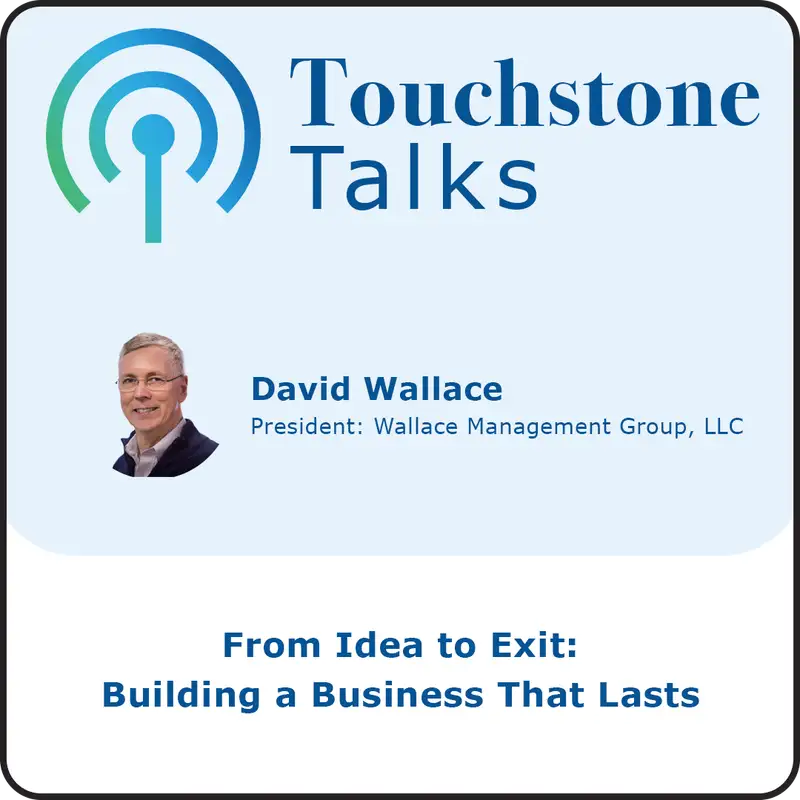
Touchstone Talks: Ep. 13 - From Idea to Exit: Building a Business That Lasts
do, assault and sand drop off.
And I spent the whole time,
telling people not to slip and fall.
And at our very last stop,
I jumped out of the truck
and landed on my butt.
And it was one of those.
I'm like,
I used to fall and get right back up.
That is not the case right now.
I fall and it hurt a little.
Yeah.
Yeah, it was, it was,
misadventure. But,
you know,
sometimes.
Sometimes.
So guys are all set to go anytime.
Okay, great.
I normally start off with just,
lead in where they, you know,
we're just having a business conversation.
Kind of similar to what we were doing,
but maybe not about me falling on
my rear end.
So, tell
me about the the last exciting thing
that you don't need.
Wholly captured, in your business.
Like somebody you met with that you,
you know, a proposal you made or something
was putting out proposals that, you know,
they're not all successful.
You know, sometimes the, clients
that we're working with,
don't recognize a need
that they've got or need to we,
you know, some number of months or years
before
it becomes
key for them to, to act,
And so, you know,
I put those out and a lot of them
come back
and you gotta keep plugging away.
Yeah.
Definitely.
They do land
with the same frequency
as you know was like but
but the, customer needs to be ready.
They need to recognize their problem,
and you need to be there
to help them, solve the problem
when they're ready.
Absolutely. So true.
So those of you guys that are just
joining us at Touchstone Talks,
we are here with, David Wallace,
who is the author of Build
a Better Business.
Build Your Own Business.
Oh, geez. How did I forget that?
Great title. Great title.
May be.
So build your own business.
And David also works with touchstone
and our Exit Advantage program,
where we work with business
owners on the on the day to day.
Thank you. You're welcome.
Thank you for joining us.
So tell us about BYOB.
So BYOB is a, idea for a book that I got
will probably, 3 or 4 months ago.
And it takes the entrepreneur
through their journey from
the idea that they've got a passion to,
to become an entrepreneur and examines
whether or not
you really want to be an entrepreneur
and what's what it takes,
and then all the way through
to putting your plans in place,
executing those plans,
putting the, the organization in place,
and then finally, evolving the business
so that it can run on its own.
And you as the, as the founder,
do not have to do everything
100% yourself that you don't have a team
and an organization
that can sustain itself.
That's great. That's great.
I always say it takes a special person
to create something from nothing.
And that's essentially
what all of our founders are doing.
They're starting with an essence
or an idea and building
a whole system for it. Yeah, absolutely.
And, you know, unfortunately,
there are a lot of, people
that get started
and never move their business idea forward
because they're not sure what to do
or they don't know how to do it.
And that's where BYOB can help them.
Understand? Okay.
What are the steps they need to take
and when do they need to take those steps?
It's not an easy journey,
and I know our business owners
will all attest to that, I'm sure.
BYOB does not downplay any of the
the challenges that we face as a,
as a business entrepreneur.
But it will help you anticipate
what you need to do and be able to put
those systems and processes in place
so that it becomes easier over time.
Excellent. Excellent.
How do they explore?
Whether or not to start the business,
that's a topic that I haven't,
encountered often in a book where
you've got to look at a couple of things.
One is you have to have an idea.
Second,
you have to have a passion for that idea.
If you want to bring it forward.
But then you also need
to take a look at yourself.
And so am I.
Do I have what it takes
to move this idea forward?
Am I willing to put in the time?
Am I willing to risk the resources?
And those might be your own resources.
They might be investor resources.
Up front early on, it's
typically your own.
Right, because the investors aren't
right to. Yep.
So until you have a proven idea,
not many people are giving you money.
And,
and so you really need to do a lot of,
self-reflection to understand.
Okay. Do I have what it takes here?
And then it will be, will will step you
through some of those questions
you might want to ask yourself.
And explore whether or not you've got
what it takes to be an entrepreneur.
It's an interesting concept.
You know, our business
is not that dissimilar as advisors.
There's risk and,
you know, leaving a comfortable,
secure job
and going into an advisory role.
And,
you know, not getting
a set salary from a big company.
But I'm seeing a lot
of professionals in the market right now
that have become disenfranchized
with their corporate job,
or they've had an epiphany
on how to improve things or,
or they've lost their job
and they're at a crossroads
and they're thinking about, I had
I had a lady call about a month ago.
And interestingly enough, I happen to know
she's a listener, too.
And she's like,
I just want to build something for me.
I want to I want to build a business
that is mine
where all my work will be rewarded.
She was very frustrated
with with kind of the corporate life.
And she's like,
I just I don't have that idea.
Or we
need to
take a look at a couple of things. One.
What are your skills?
What what do you have experience doing?
What are your passions?
What do you want to be doing?
So those two are both very important.
When you do have an idea
as to how you want to apply those
skills to that passion,
you also need to take a look
at who else is doing this right.
What does the market look like?
Other competitors that are doing about
who would be interested in buying
what it is you're yeah, you're offering
are you solving a problem?
That's that's really a key identifying
problem that's out in the market.
And then having a solution
to that problem.
And, you know, once you've answered
all those questions and answers
came back positively,
then you can start looking at, okay,
now how do I build the organization?
How do I take the next steps to execute
on this idea that I've I've developed.
But and it really takes some planning
and introspection upfront.
Absolutely. Absolutely.
You know,
we see people looking at the businesses
that we have at market
kind of from the same pool.
That and
so there's always the kind of the flux.
Do I start something from scratch?
Do I find something
that's already been established
and operate it and change it?
So yeah, there are different ways that
you can go into business for yourself.
One is with a brand new idea
that hasn't been in the market before.
And you look at people like
Bill gates when he started Microsoft
or Mark Zuckerberg when he started,
Facebook.
Those were not products
that were out there
for the those two individuals,
took advantage of it.
Other times you're looking at the way,
technology is changing markets.
And over there
taxing companies all over the place.
Right.
But the way that, you know, cell
phones and cell and cell phone
apps, became ubiquitous,
back in the early to the late 2000.
Uber was able to take advantage of that
and build on that to create.
Absolutely.
Absolutely.
Well, and who would have thought
there was an app that you could punch in
and get a somebody to walk your dog,
walk the dog,
or rent a room in your house? Yep.
Or write your your house out. Exactly.
Or swap a house for.
Exactly.
Like, there's there's just a whole lot
of interactions as we change the way,
that society operates.
Yeah.
So those those are ways that,
you know, as technology changes, that
it might open up opportunity for you to,
to build the business.
But as you said,
you can also look at existing business.
Here in Connecticut
we have a lot of manufacturing businesses.
They're very well established.
And they have very good,
very solid clients.
But they've been around for,
you know, 80 years, 100 years.
Any cases.
Are there, is there room for them
to change their processes
to be improved, to become more effective
and more efficient?
I think that's kind
of almost always the case.
And so you may come in and decide
that you want to pay,
pay for one of those businesses
and then improve it.
So that might increase its value. Right.
I had a, one, one client that we met with
that was, an MSP client.
And when I went
and looked at their original tax returns,
they were a typewriter
repair shop when they opened.
So just because something starts out
as one thing, it doesn't have to.
In fact, it's
probably shouldn't be the same thing.
As exactly.
When IBM started in the, early 1900s
and they were data
tabulating and recording
company
and it was basically doing census work,
and they would do punch cards
and manually record a lot of these things.
They've, they've,
they've improved that a little bit.
And technology helped them along.
Right.
You know, they became one of the founding
companies of the whole,
computer industry.
Yeah, it's it's, everybody gets to
put their mark into it and, and adjust it.
Generation by generation.
Yes, absolutely.
I think that's a, a market that,
you know, comes down to,
help take advantage.
Right. As owners move,
their businesses
to the next, set of owners.
Sometimes the, businesses
are ready to move.
Other times they're not.
And so, you know, touchstone offers
a program like Exit Advantage.
And maybe they're
2 to 5 years out
before they're ready to move.
And touchstone is able to come in and work
with those businesses to identify
where can you strengthen the business,
where can you and efficiencies
and improvements so that the valuation
of that that company goes from
a, a modest valuation to something
that is much stronger?
Right. Well, and that's,
you know, that's a program.
And when at its conception,
what we were seeing is,
a pool of clients that came in and said,
we do the valuation.
It's worth, you know, 5 million,
I want 12.
That's a pretty significant gap.
So there's not, you know, the
the market is not going to bear the price
that they wanted.
So then it's it's let's look at
what's the difference between a company
like yours valued where it is now
versus what you want to exit at.
Yeah.
A lot of times, what I see in companies,
they're looking to sell
particularly that have been,
that are owned by their founders.
Is that they take on a lot
of the responsibility for themselves.
And if you sell the business
and that founder,
that owner goes away,
what are you left with.
Right.
And so we help those owners
put the structure
in place, put the processes in place
in the organization in place.
So it's not all dependent upon one person.
Right.
Actually increases
the value of the business 100%.
Maybe not two times.
They might have to do
some other things too.
But yes.
You know, there are pinch points, right,
where a company is
constrained at a certain level of revenue.
And it's kind of grown to its threshold.
And you have to change something
inside the company
to take it to the next level,
not just sell more.
Right. The if the,
the choke points might
be in sales,
it might be in the operations,
the manufacturing,
it could be the way the books have been.
And there are a lot of different things
that you need to take a look at.
And, you know, a company like,
touchstone coming in with the reserve
manager can help you identify
what are the areas of weakness
within your business
and then hang with you and advise
you on how to strengthen those so that,
the company is more valuable
than it would have been otherwise.
Right.
Well, and,
you know, the fact that there are
things that are less than ideal
is not a reflection on poor ownership.
It's just that
the owner is nose to the grindstone,
probably seven days a week, 12 hours
a day.
Working on
getting things done in the business.
It gets to a, another point in my BYOB
and build your own business.
And that is that at one point,
you need to switch
from working in the business
to working on the business.
You know, early
on, you might spend 60% or 80%
of your time working in the business
because things need to get done right.
But as your business grows,
you need to flip that so that maybe you're
working 20% in the business
and 80% you're working on the business.
And what does that mean,
working on a business
you're looking at at the bigger picture.
What does your strategy look like?
What are your markets look like?
You know, how are you stacking up
against the competition
as opposed to,
you know, if I you know, if I,
fix these
dials or change out this machine,
you know.
Right.
We're getting a better process,
and you need to look at the bigger picture
and having a team
that can handle the details.
Yeah, and that's hard to do, right?
Like, you know, for for lots of owners.
This is your baby.
This is what you grew.
This is what you developed.
And to be no longer
the one that needs to send
the invoices
or needs to schedule all the people
or meet with every client
because you always met with every client
to to take that step back and entitle
your people is a hard stop.
When people do with what do things
that they're comfortable with.
And you know,
if you've always been an outside person
and and working with clients
and meeting with everybody,
you know, that's
where your comfort zone is.
And so you you do those things,
but then you ignore
other parts of your business
that might need your attention.
Happens it happens quite a bit.
And you know,
I can't tell you the number of clients
where I've spoken to them, where
they want to know,
how do I get back on the growth path
that I had, you know, five years ago
or ten years ago or even one year ago.
And the answer is often, well, what
got you here isn't going to get you there.
No, to change that. Right? Right.
Because you've built the business
to this point.
And kudos.
But that's not going to be enough
to keep going.
Yeah. You're not done yet.
Exactly.
No. Somebody ask me when they need
to start thinking about exiting.
And, my answer is always
when you start the business.
Like, you need to think about that
at the beginning.
What is the exit potential of this?
And if you can't see an exit,
then plan something differently.
But basically the goal that you're
you're setting for yourself
and goal, you're setting for the business.
Are you building a business
just to satisfy yourself?
Is it going to be a lifestyle business
where it, you know,
provides enough money to
to buy the new car or buy a bigger house
or buy a second, second home
on the on the beach or in the mountains?
Or is that you?
Are you looking to build a business
that will, make a change in the market
that will, you know, employ,
you know, a, a staff and a team?
And you're you have no problem
with the business being responsible
for those those people being able
to have the bigger car, bigger house.
Right.
And those sorts of things.
And what is your vision
for for the business?
Is it all about yourself?
Is it about your company?
Is it about the community
that you're serving?
So you need
to take a look at those questions
and ask ask those questions and,
and come up with a,
a set of goals for yourself
and then put a strategy in place as to
how am I going to accomplish those goals.
And those goals might be, you know,
two years down the road, five years
down the road,
ten, 20, 30 years down the road.
But set some ambitious goals
and then work to achieve those goals? Yep.
Definitely.
If you don't, you know, I get pushback
even with, even with Touchstone Partners.
Why do we set these goals?
Why are you making me do rocks?
Why are you making me like,
why do I have to do this?
It's just fluff.
If there's
no goal, you'll never get there.
And the goal
without a plan is just a hope, right?
That you'll also never get there.
So that that kind of backwards planning.
You know,
where do I want to be in ten years?
Where do I have to be at five years
to get to the ten year
if I want to be there by five years?
What's my two year?
Okay, well, then what has to happen now?
Yeah.
No, you're absolutely, absolutely right.
And yeah, I would say, as you're
developing your strategy,
for the business, as you're
setting the goals for your business.
Yeah. Don't be short sighted.
Look, look far out.
Make your goals big.
Make them audacious. Yep.
There's a, a book. I'm trying.
Remember who it was? The author.
But they define wildly important goals.
Okay.
For your business.
And you can set wildly important goals for
each year departments.
Or have the departments
come up with them on their own.
But a wildly important goal is one that,
is achievable.
But it's hard, right?
But once you cheated, it's
going to move the needle in terms of,
achieving your ultimate goal.
Excellent. Excellent.
I like that.
That thought process aligns
with, the way I plan.
I'll give you the book.
Excellent.
So I did read your your previous book,
which was on sales management.
Talk a little bit about what
it looks like to grow sales and manage
that process.
So in sales management,
it's really important for you to,
to understand your goals, understand
your strategy,
put your team in
place, hire the right people,
when they are in your,
your sales leaders, your direct sales
force, your channel sales force,
are the inside sales whatever,
to put all the right people in place.
Make sure they've got the skills
that they need.
So that's that might be training.
It might be hiring, the proper skills.
Make sure that they're fit with your
your company and your company culture.
And then you really take it through to,
you know, setting up their territories
and identifying who their, their,
their target customers are.
Put all of that in place,
but also, you know, besides
all the internal pieces and the processes
that go in place in sales
also need to work
with the other parts of your presentation.
If sales can't work alone,
you need to work with finance, right?
And place to be able to support right
sales that come in.
Do you have an inventory in place? Yeah.
To be able to, to deliver on the sales
policies.
Yeah. People in place.
You gotta work with each other
to make sure you got that.
How about putting this marketing in place
to be able to support the salespeople
to generate all the leads? Yeah.
So often, you know, in sales,
the answer is yes.
Of course I can do that and then figure
out how to make it happen afterwards.
And that that's probably
not the most efficient way to do that.
I know, do you, a partner in earlier
business of mine, and I was responsible
for most of the operations
and delivery of of our services.
My partner was the sales guy,
and, he would come in and say, Dave,
I just so you know,
you know the following services company.
And I said, oh,
how are we going to do that?
So we don't offer those services?
Well,
I don't know, but you'll figure it out.
Yes, we have
we have had similar conversations.
It was the entire reason to go.
Process process, process.
Process is important
and communications is important.
Holding you know conversations
between sales and other other functions.
Yeah. Organization as well.
And then the other piece
that I hadn't really touched on
is setting goals, not only for the sales
organization and the overall organization,
but setting goals for each of your sets
to write them as, as folders.
And they might be a product or service.
It might be how many new customers
that you land.
It might be how much penetration
into the new market,
that you're targeting.
And, you know,
you've got to set those goals.
For your, your sales people
and then hold them accountable
to achieving those goals
and reward them for achieving them.
Absolutely.
You more than for achieving them.
But to have communication
all the way through.
Correct.
To make sure that
they're not felt as though they are,
left on a desert island by themselves.
Right. Right.
It breeds desperation. Yes.
I've seen. That's not a good look, either.
Well, thank you for joining us, David.
We've got,
one last question that I always ask.
If you were not a sales consultant,
you were not the role you had today.
What other career would you go into?
Maybe I could be a doctor.
Yeah.
I like to solve problems.
Okay.
Diagnostician.
Diagnostician or surgeon
or something like that.
That would be fun.
Excellent. Excellent.
Well, thank you for joining us
on, Touchstone Talks.
It's been great to have you.
If you have not, liked or followed
the, Touchstone Talks podcast,
please do so below.
David's contact information website.
And a link for Exit Advantage
and for his book.
If you would like to BYOB, with him.
We'll all be on our page.
BYOB is due out in January.
Congratulations.
Meet. Him.
Maybe it.
Means we.
Creators and Guests