
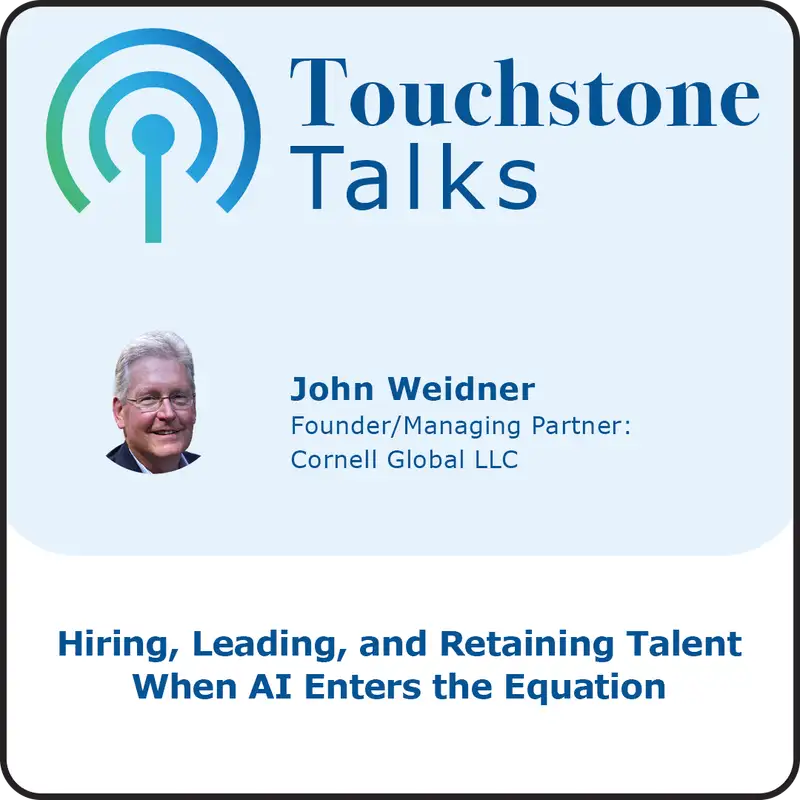
Ep 20: John Weidner Hiring, Leading, and Retaining Talent When AI Enters the Equation
They had
said that.
It actually
is not every. Day.
That I.
Meet. Him.
Maybe it.
Means we.
May be.
Okay.
And he is.
Back.
And we.
May be.
In the.
Me me me me me me me me me
me me me me me me me me me me me me me me.
We me
me me me me
looking for what I wanted to do
that had more purpose
than the contracting company
I used to get me through college.
I ultimately, for various
reasons, was attracted.
I was in Boston and walking down
Commonwealth Avenue and saw Danielson
Counseling Center, and I thought,
okay, wow.
So I was psychology major
minor rather, and it made a lot of sense.
Let's go in.
Let's see how they and I had actually
just come from talking to the
to the psych department at Bu
and was very unimpressed.
I don't want to do this.
And I walked in.
Okay.
And I walked into the Daniels Center
and a fellow named Homer
Jernigan was standing around.
He looked just like Freud.
Literally, you spitting image of any image
you've ever seen or Freud. And
back in the day, I'd rather long hair.
Oh, and and he probably thought I was
a student looking for for for therapy.
I probably needed it then anyway, but I
and he said, so what can I do for you?
And I said, well, I was over
at the clinical psych department
and that's not very impressed.
Tell me, tell me about your background.
Well, I had walked into the School
of Theology at b u o,
and the Danish Counseling Center
was a pastoral counseling center.
And as he walked through the discipline,
which was very Jungian,
which had been my favorite
read in college.
Wow, this could be it.
Long story short.
Neither the collar nor therapist fit
for several really personal reasons.
Part of which is, as a therapist,
one of the things you need to do,
just like a doctor,
etc., is be able to put aside the pain
that you're experiencing
from an empathetic perspective
with anybody that you're dealing with.
And I wasn't very good at that.
I was taking it home, and I really saw
some horrible things in people's lives
that I couldn't
block out when I went home at night.
It led me to human resources,
ultimately friends of mine in my church.
Oh, you should get into personnel.
You like people.
You do like people.
For those of you that don't know John,
John knows everybody.
But you know, the net of it
was, is that you like people.
And then he gave me some books. Okay.
And HR still hasn't fully realized
the theory that I read 40 years ago.
But it really made sense
because initially personnel
was the employment office at Macy's,
which could not be less
what I would want to do with my life,
but worked out.
I ended up joining Price Waterhouse
as a human resource generalist,
knew nothing about accounting.
Frankly, when I went in there,
I was a rare hire.
They thought,
oh well, he might be good at this.
And I was an experiment, literally.
And the recruitment partner
at the time decided because again,
because my background,
I make a great recruiter because of course
I understood the psychodynamics of people
and would be wonderful at it.
I'd never done it before. Of course.
And but it was a great experience.
I mean, I think the lasting impact
that I took from Price Waterhouse
was, first of all.
How to
really do performance management.
They did a great job.
Everybody got reviewed.
The only thing they didn't have
was the individual conversations,
but it was a great introduction
to performance management.
It was a great introduction to recruiting
because art
had it set up that
we had as recruiters going out to campus.
As we see, I probably would interview
350 400 kids on campus, all accountants.
I had a wonderful cross-section
of what the talent was,
and when we got them back to the office
and a partner
liked somebody for whatever reason,
and I would raise a flag.
I had a final vote
that and I could have vote a partner,
which is unheard of in an accounting firm.
It's how he had to set up.
So I also knew
that those people who were hired,
I then had to deal with on a day to day
basis because HR, primarily
an accounting firm, puts the talent out
on the client assignments.
And so you're a manager's best friend
to get the best people
who are the best people in this class,
etc..
And I was hiring them. That's fabulous. So
you were
really on the line a lot of different ways
that retrospectively, at the time,
I didn't think about it.
I wasn't realizing how unusual that was
making hiring decisions
for a major company.
And it really
it really laid the groundwork
for a lot of things that I've done since.
Well, I think you just touched on
some really key
things, like all the major components
that we deal with as business owners
getting them, keeping them
and managing them.
Right.
Like, that's that's what you have to do
to keep the company going.
Right.
So let's kind of jump in with,
you know, that that was your softball.
Here's the harder one.
We're evolving as a society.
AI is stepping in. Amen.
Many people are
singing its praises
that, you know, they can use an AI agent,
build an AI agent,
use it for less money than hire somebody.
It's a disruptor, though.
So how is that impacting
our current hiring situation?
Profoundly.
The the full power of AI
is yet to be realized,
and certainly how we adapt it
to what has always been a human centric
process is, again, very challenging.
What do we find in the marketplace?
Most recently,
among other things that I've been doing,
I got very interested
in the engineering space.
I've been doing recruiting in the
engineering space, and one of our clients,
just one illustration, one of our clients
has, because of the volume of need
in engineering, added AI into
their recruiting processes.
So they're using AI to help
with the recruiting process,
or they're filling spots with AI.
They're not filling the spots. Okay.
And I'll get to that okay.
Because that's actually more loaded
than you might think.
Oh, I know it's good.
That's
why I wanted to point it out and clarify.
You can
AI is generating their job descriptions.
Okay.
And so the extent to which the managers
touch is involved in it I don't know.
The robot is between us
and the recruiter now
so that we will get
open job recs sent to us
on an automated basis.
With no conversation with the recruiter.
Now, working with a corporate recruiter,
depending on how good they are,
is not always optimum in terms
of being able to find talent. Why?
Because they may
or may not know enough about the job,
the culture of the particular job,
the needs of the job, etc.
that that added flavor to what
this job actually will entail,
what is actually going to be doing,
how it actually fits in the organization,
what the client relationships might be.
And it all that softer stuff
that you can't write down on paper.
Right.
And that's the conversation
with the hiring manager.
The hiring manager is getting farther
away from the recruiter.
Oh, at least in larger companies.
Okay.
And what
happens as
a result is that in this particular case
of this company,
the robot is making decisions
on resumes
before anybody's read them.
Very true.
And while that does
take care of the volume of paper
that comes in over the course of a year
to accompany and thus sort it,
the extent to which it's then that data
which is actually accumulated
gets reused is amazing,
because I can't tell you how many
with this particular company
we have found this and that quality
candidate for them
that was actually in their database, but
they hadn't found them in the database.
Oh, so they literally already
had that person.
They already had that person.
But we found them. And unfortunately,
since it was in their database,
we couldn't make money on it.
Oh well, that's a facet.
So yeah. So it's
it's an AI is a very challenging process.
Now here's the plus side of it.
One of my colleagues
has invested not a lot of money,
about 12 grand, I think he told me.
And to into an application
that can control his prospecting
for candidates and
it can bound email type scenario.
Well it does two things.
First of all, I think it works like a
I again, he's just telling me about this
the other day.
So I'm not going to be 100% clear on it.
But as I understand it,
first of all, it has.
If you're familiar
with the idea of of of an internet spider,
they can go out and pull data out.
Well, that's one of the things
that AI does unbelievably now.
Correct.
And so this particular app is able to
go out and identify multiple
prospects.
He's talking about surveyors for example,
in a particular marketplace,
all the surveyors in that marketplace.
And somehow it generates the actual
their actual emails to digs them out.
I don't know how that's working.
I have no idea.
That's phenomenal tech scraper tech.
And but on top of that, now he has it.
Now he has a database
of people to contact.
And so what he's
what he's also able to do with the app
is to personalize the approach
to the candidates, literally with a video.
Oh, send an email with a video attached
saying, I'm so-and-so and this is a job.
And this is how I understand.
And this is what the kind of person
we're looking for, etc., etc.
and the feedback he's been getting from
candidates is unbelievable.
As you can imagine, it's
finally I'm talking to a person.
I'm not getting this
cold call out of nowhere.
I get emails,
particularly engineering space.
You get hundreds of emails
because it's such a desperate
need in every aspect of engineering
right now in the country.
And this is not personalized.
What a beautiful way to use AI.
So the AI used his image on the job
description
and personalized a video
for the candidate.
Yeah, he basically does a podcast
like we're doing right
now, in effect, to describe that job.
And and you got fabulous
responses from it.
Oh, I'm sure the problem
that you will find now with applicants,
I did I did a presentation back,
I think you were there when I did it.
And one of the weird statistics
that I found was in,
I think it was in for for 2025,
only 16% of applicants
actually were getting hired.
Think about how many people are being left
to the side now.
Part of that's AI.
Part of that is,
is whatever other factors are involved
in making hiring decisions.
Certainly, AI has
purportedly will replace 20% of all jobs,
but other jobs will be created
as a result.
For sure.
AI has all kinds of wonderful
strengths to it,
but it's how we apply it in the end,
and we're still figuring that out.
What's the effect in the context
of how you run a business?
Well, AI is a 24 over seven
constantly demanding,
constantly active technology.
It just keeps doing.
And as you train it more,
it keeps doing more.
And therefore people have to keep up.
Right.
And it's very threatening,
very hard, very depressing.
Much of AI has not proved to be
the cost saving
that has been purported to be.
That doesn't mean
it won't be right. But not yet.
No, because right now it costs to build.
It costs to fund the electric
cost goes up.
Like there's set costs
currently associated with it.
Yeah.
And the other part of it is, is that
is that you've you're now
creating a new culture
in this automation and culture
is always the driver at the end of the day
of a successful business.
And culture is,
of course, driven by the people
themselves in the company
and most most prominently by leadership.
So is
leadership ready for the new challenge?
Now, interestingly, when you read
what's being written about AI, HR, etc.,
it's talking about this
new approach managers need to take.
I scratch my head and go,
That was never it's not new.
This so-called new approach to management
is that
managers need to be more relation
oriented with their employees.
Well,
of course they always had to be said.
That's not different.
That's always been
what what drives engagement in a company?
At the end of the day, first line managers
is main reason why people like to stay.
Also,
the main reason why people often leave
is because their managers are not doing it
right.
And I do agree that AI.
With without high AI,
we've always needed to have managers be
much more high touch with their employees.
If you want to drive engagement,
you want to drive development.
You ultimately want to drive culture.
It's extent
to which a manager is invested in number
one, their employees,
they're the team leader.
They're driving
the success of this business. And
Michael Stanley a
booyah I'm blanking I had to say
he's an Australian coach
wrote writing the coaching habit.
Great book for anybody out there.
Read the coaching habit.
What does it teach.
Teach us something very simple.
Every manager has an opportunity to coach
by doing one of two things.
If you somebody
if your employee comes to you
with a problem,
you tell them how to do it.
You haven't taught them anything.
You just told them how you would do it.
If you sit down
and process the solution with him or her
whole different ball game, they now learn,
they developed, and a lot more.
Of course, as you can imagine, that
personal touch made so much different.
The empathy. So the.
The leader in the AI
world will have to be
that empathetic person.
We've always wanted that
that that empathetic leader
that that knows
what's going on in the relationship
between the person across the desk,
from them and within themselves as well.
What's going on?
But I think you're right.
I think that's always been everybody's
favorite leader.
I did a factory tour,
I don't know, about a year ago,
and I came home and I told my husband
and I said
it was like
the Disneyland of places to work.
I was like, it was clean.
The floors were clean, everything.
Everything was clean.
There was no doubt about it.
It was manufacturing.
So that's not always the case.
But more to the point, the owner
walking through the floor with over 100
employees was greeting them by name,
asking
about kids, talking about current projects
that they were working on.
Oh, I saw what you did here X, y,
Z giving the praise
in regards to the same projects
and in a way that didn't seem
forced or uncomfortable or unusual.
And the people themselves
in each department
obviously interacted similarly.
I was like, it really was.
It was like Disneyland. I'm like,
I want to go work there.
And I think that culture is built
across every company
that's operating,
whether it's good or bad culture.
So if AI creates situations
where only your good management
lasts, that's
not necessarily problematic.
Yeah.
And I was reading an article
by by by Daniel
Goldman, who's one of the gurus
in emotional intelligence about
some of the demands, some of the demands
that are being created by AI,
beginning with urgency.
Now that you have all this data,
information, etc.
available to you at a touch of a button,
you're supposed to be able to work
much faster, much more, you know,
get things done much sooner and
quicker and with less people.
Does that
really work at the end of the day?
Not necessarily
so, as depends on the workflow.
And as a manager, when you have this
urgency and being pressed from the top,
you know, how adaptable
are you going to be to,
you know, you're just going to drive
the urgency and drive everybody crazy?
Are you going to calm down,
use your internal agility
and work it through in a calm way
and not let urgency take you over?
It's a fascinating
it's all very fascinating because
one of the things we were talking about,
one of the things I'm aware of,
I have a candidate
going into a client on Friday
who is what I used to call back
in the day, a best available athlete,
perfect
checkmark in terms of the boxes
that they had laid out.
But no, not completely.
Oh, but nonetheless
a phenomenal talent with civil engineers.
Amazing stuff, but not everything.
Okay, so missing some now
AI would have bounced this guy, correct?
I say that missing those boxes is bad
because and and in engineering
the tendency is again to check the boxes
anyway without the AI.
But in this particular case,
the matter manager looks at the back.
Yeah, I mean, I love the super,
I love the super.
All the stuff that all the softer stuff
that in the right up
I put in that he that he read
between the lines on the, on the resume.
I really see how this guy could be
a real impact player
in my company, even though he doesn't
check all the boxes.
And that is the way
recruiting used to be.
That was that was when recruiting was
the most fun, is
when you could really come up with a
with a diamond in the rough and,
and watch that person
come into a company and take off.
Today it's harder.
So do you think internal mobility
is going to be a problem in the future?
Interesting question.
I don't know at one level understand
you don't have a crystal ball
that's functioning. That's true.
You know, at one level, succession
planning, succession development with AI
should be able to be done better
because you're able to collect more data
in a more rapid fashion.
And also in terms of predictive analytics,
AI again does a great job in terms
of of helping you identify the risk
in your organization, beginning with
who's here to stay, who's not
where, where are the blocks across
the organizational structure
that that may inhibit
a star player from moving ahead?
And how can we then adjust to that
so we don't lose this person?
What can we do with them
creatively to keep them challenged
and filled with purpose?
So there's a lot of great potential
that it could come.
But then again, I'm not always sure that
that companies have always done
the best job of succession
planning to begin with.
The thing about HR
that we don't talk about enough
is that it's all the all
the various modules, if you would, from
from workforce planning to leadership
development to recruitment,
you know, even even rewards,
you know, comp benefits, etc.
it's all integrated.
It's all why is it integrated?
Well, it's all focused
on the individual employee.
All those at once are focused
individually on the employee.
So it's an integrated process.
And you can't do succession
planning over here
without having performance
data over here.
And if you build a model
that's centered around
performance management,
if you would everything connects,
then you know,
you know where your strengths
are organizationally
from a performance standpoint.
It gives you an idea of what you got to do
from a workforce planning
standpoint, where my strengths
or weaknesses are in the team.
It gives you an idea of of
where your high potentials are going
and where you're going to invest
in terms of succession development.
So it's it's and again,
AI has the capacity to really help
with the collection of that data.
Because certainly back in the past
a lot of it was subjective.
You don't want to take
the subjective out.
I think as you read this, we're talking
about too much objectivity, too much data
driven decision making without taking
in that other softer side of it.
But but there's also an overabundance
of data.
Yeah.
So you have to kind of filter through
that and look at what actual
KPIs are important for the decisions
that you're trying to make.
Right?
You know, we've created something
that can gather
the number of mouse clicks on a website.
Well,
unless you're evaluating that website,
that's largely a material
for the rest of everything else.
So you really have to kind of target
what data you're using
and what you're doing with it.
Yeah.
We also have a challenge
and another piece of the data
that's out there
in terms of of of engagement,
I certainly recommend
anybody who's not looking at it
to look at the most recent global
engagement survey by by Gallup.
It gives you a lot of data
that is useful, beginning with
how many of your employees
are likely engaged,
how many of your employees
are likely looking like 50%?
That's crazy.
And I
just want to poke on that for a minute
to make sure everybody understood
that was 50% of your current
employees are looking
for employment outside of your company,
looking or listening.
Yeah.
And that's
because only 30% of them are engaged.
And AI is adding to that right now.
But adding to that
because it's filtering more emails in.
Yeah. No,
let me back that up a little bit.
If one of the things that AI has done,
from what I've read,
I don't know this to be a fact,
but Anna Tavis, who's a runs
the HR program graduate program
down at NYU who brilliant woman does
is a voice in the space, in my opinion,
wrote an article about how
middle management is beginning
to disappear, in part
being replaced by automation.
Right. And yet,
which may account for the fact
that if you think your employees
are disengaged,
take a look at managers now.
But that said, leaders
managers are going to be point
in terms of making AI successful
if they're disengaged, no wonder
their employees are disengaged.
If they're disengaged, how excited
are they going to be with the changes
that they're going to have to be involved
in the literal cultural change
as this new technology comes in?
I'm old enough to have been around
when the first computers
started showing up and changing our lives.
I'm on enough to have seen the first
applicant
tracking system suddenly developing,
which were phenomenal.
I mean, they weren't AI driven at all,
but they were algorithm driven.
And as they developed,
you began to be able to, again,
sort data
in ways that you couldn't do before
because in manual files,
imagine hundreds of resumes in a file.
That's how it was back
and then terrifying, actually.
And and so this new technology,
you know, properly applied
and properly understood and again,
I emphasize we're still understanding it.
We're still at the early stages
of this adoption, even though every CEO in
America says we got to do this,
we got to do it and got to do it quick.
But if we don't think through how
what we're gaining,
what we're losing by implementing, etc.
and again, I don't have all the answers
for that because we don't know yet, but.
We can't count on robots
running everything
as effectively as humans do.
So no. And that's a good thing in my mind.
Yeah.
Like, you know, several several people
that do that do my job or like,
oh, we're not going to have jobs.
AI is going to take over
everything we're doing.
I'm like,
there's absolutely no way that AI
can personalize
to deal with a business owner, right?
To help
coach them through a process of any type.
That's a human capacity.
So maybe pieces or bits
or bobs will be easier and automated,
but I don't think we're going
to take human capital out of it. No.
And yet that said, you know,
you know, here in Connecticut.
I assume people in
Connecticut know this, not, you know,
anybody seeing this from outside.
I mean, we're leaders
in advanced manufacturing.
And the stuff that tech is now able to do
in a manufacturing environment
without the hand, the hands of people
touching is unbelievable.
I mean, it's just incredible stuff
and that's all good.
And get the part out.
That's all good.
And but again, it's how you manage
the people, the people that are involved
in that environment
that that becomes very critical
to make the ultimate great company.
But again, there's so much cool stuff
going on here in Connecticut.
There's so many, so many,
so many smart things going on to solve
some of the labor issues we're facing and
and particularly manufacturing.
Check out the programs that Paul Lavoie
has put into place
at the University of New Haven.
For those of you who want to really look
at some really neat
ideas about, simply put,
Sikorsky, the helicopter
maker, could walk into Paul's office
and say, we need five of these.
And Paul will say, okay,
so we'll, we'll we'll make them here.
That's impressive.
Now that solves a problem. That
is, is is beginning to expand
in tech schools, etc..
That is a particularly exciting
time to see that.
Fairfield County in
in Connecticut
is is very well to do community
much new York banker, lawyer, doctor, etc.
but a lot of the kids aren't necessarily
that may not be the best career
path for them though.
Mom and dad may disagree,
but we now have an opportunity here
to take that kid
with good technical intuition.
That's a pretty good idea.
That's a good word.
I've never used that term before.
Technical intuition.
And who would belong in an environment
where they're working with their
hands, making things? And
that program at
University of New Haven
is wonderful for them.
Same with the tech schools
where we don't make
young people aren't
going into being machinists,
but somebody has to, you know, polish that
do the final polishing
and clean up of of certain end products.
We still need machinists.
Don't knock them.
I know, but most machinists are now
well into their 50s
and heading towards retirement.
We're not making them.
I know we got to fix that.
So got to fix that.
So. Well, thank you for joining me, John.
It's been great chatting.
Lots of practical and
and philosophical advice
on where business owners
should be considering and how
they should be thinking
about hiring, firing and and maintaining.
So thank you for that.
I ask one question
at the end of every presentation.
If you were not doing this,
it sounds like you did
some exploration at the beginning.
But now that you have lifetime wisdom,
if you were not doing this,
what other career?
What would you do when you grow up?
I'd probably
be a D1 basketball coach.
Okay, I could think of nothing more fun
than going to the Final Four
and winning.
I mean, I think honestly,
there's still value in losing.
There is. Right?
You learn
I think if you ask everybody would
I think I think if you ask Gino or R.E.M.
if that was if there was a learning
experience there, he disagree with me.
But I but
you know, the men's coach would say so
we learned a lot.
We shouldn't have been here to begin with.
Well that's a very powerful statement
to put out there.
No I mean he didn't
think he had the talent to get there.
Yeah.
And and it's again if you want to have
a great model for,
for how to run a business, take a look
They had
said that.
It actually
is not every. Day.
That I.
Meet. Him.
Maybe it.
Means we.
Creators and Guests